“How do you tell the languages apart in your brain when you speak Danish?”
One of my earliest memories is asking my older brother that question. He was eight years older than me and could already speak Danish and English. It really occupied my mind—how two or three languages could all be running around in one’s brain. I imagined that it took an extremely long time to learn a language, and that only the most quick-learning people could do it.
I had never imagined or set a goal for myself to learn a foreign language—it wasn’t my main goal.
For most of my time in elementary school, I didn’t have a teacher who was fluent in Danish or English, because we moved around a lot and changed schools quite a few times. My parents weren’t fluent in any other language either—only Greenlandic.
But in 8th grade in Ilulissat, we finally got a teacher with a language education, and I was finally able to learn real math and physics. This meant we received a higher standard of education, which I had longed for. Even though I grew up in a village with fewer than 200 people, and the nearest town was 200 kilometers away, I was an open-minded and curious child. I wanted to achieve the same things as my older brother, who was already a quick learner in languages and math. Before long, I began to enjoy learning languages and the various subjects we had in elementary school.
I moved to the student dormitory in Upernavik when we were forced to move back to the village. At age 13, I left my parents and moved to Upernavik because there was a shortage of teachers in the village. It was normal and not surprising that my classmates hadn’t learned anything in Danish because they couldn’t speak with or understand our Danish teacher.
But I could tell that I understood a little more than before.
Our Danish teacher, Peter, came over to me after class and asked quietly, “Sikki, can you understand what I’m saying?” I replied, “Yes!”
I remember it as the first time I spoke Danish with a Dane. I was 15 years old at the time. Our teacher looked very happy when I understood him, and he promised me that he would teach me more and that he would tell his wife about it. He had even told the other teachers how good I had already become at understanding Danish.
Unfortunately, Peter had to leave, and I lost the opportunity to receive a good education.
But our homeroom teacher took the matter into his own hands and worked to move me up to 10th grade and skip 9th grade, because I was ahead of my classmates and should have the opportunity to attend a boarding school in Denmark, now that I was learning Danish. Unfortunately, the principal turned down the request because I came from a small village.
“Sikki, go see the guidance counselor and fill out an application—that way you can go to a boarding school after 9th grade, because you’re not going to learn anything more here anyway!” I did as I was told and went to see the guidance counselor, who sent an application to the boarding school. My parents didn’t find out until after I’d been accepted—that’s how quickly it all happened.
I attended Kongenshus Efterskole. There were 37 students there, and I was the only Greenlander. I stayed with my aunt before I started school, and I had blisters because I’d gotten new shoes. On the way to boarding school, my aunt taught me that when I arrived, I should say, “Do you have blister bandages? Blisters are ‘qaattoorneq,’ so they’ll give you bandages.”
They ran every morning at the boarding school, and they were very interested in me and tried hard to teach me Danish. But I wasn’t athletic and no longer felt that my boarding school was the right fit for me. That’s why I moved to Klank Boarding School just a month later.
There were seven Greenlanders at school. I became lazier and didn’t learn much because I was always hanging out with another Greenlander, who was my best friend.
I learned a lot of everyday Danish. But it wasn’t until two years later, when I started high school, that I realized how important it was to learn Danish—that it was crucial for my future. I could tell from some of my classmates that they were good at Danish because they had lived in Denmark themselves.
When I was in high school in 2014, I really started learning Danish and English. Ever since I was a child, I had been working hard to get better grades, and now I was working even harder.
The years went by. I did well in high school, and I was accepted into the law program at Aarhus University. Although I found it difficult to learn all the new academic vocabulary, I didn’t feel like it was hard. It was more the change in lifestyle and the fact that, for the first time, I was living away from home on my own as an adult that was the hardest part.
I had some really helpful classmates who always asked if I understood the topics we were covering. They made sure to help me with my notes when we were in groups so I wouldn’t fall behind. I’ve struggled for a long time to learn Danish. It took me six years before I began to understand it, and four years before I learned to speak it.
I grew up in a country where Danish isn’t spoken and have been surrounded by very few Danish speakers. Fortunately, I’ve always met people who have helped me. I have never met a single Dane who excluded me because of my language, my appearance, or my identity. Unfortunately, some of my Greenlandic friends have experienced such severe discrimination that they believed all Greenlanders had to speak Danish 100 percent fluently.
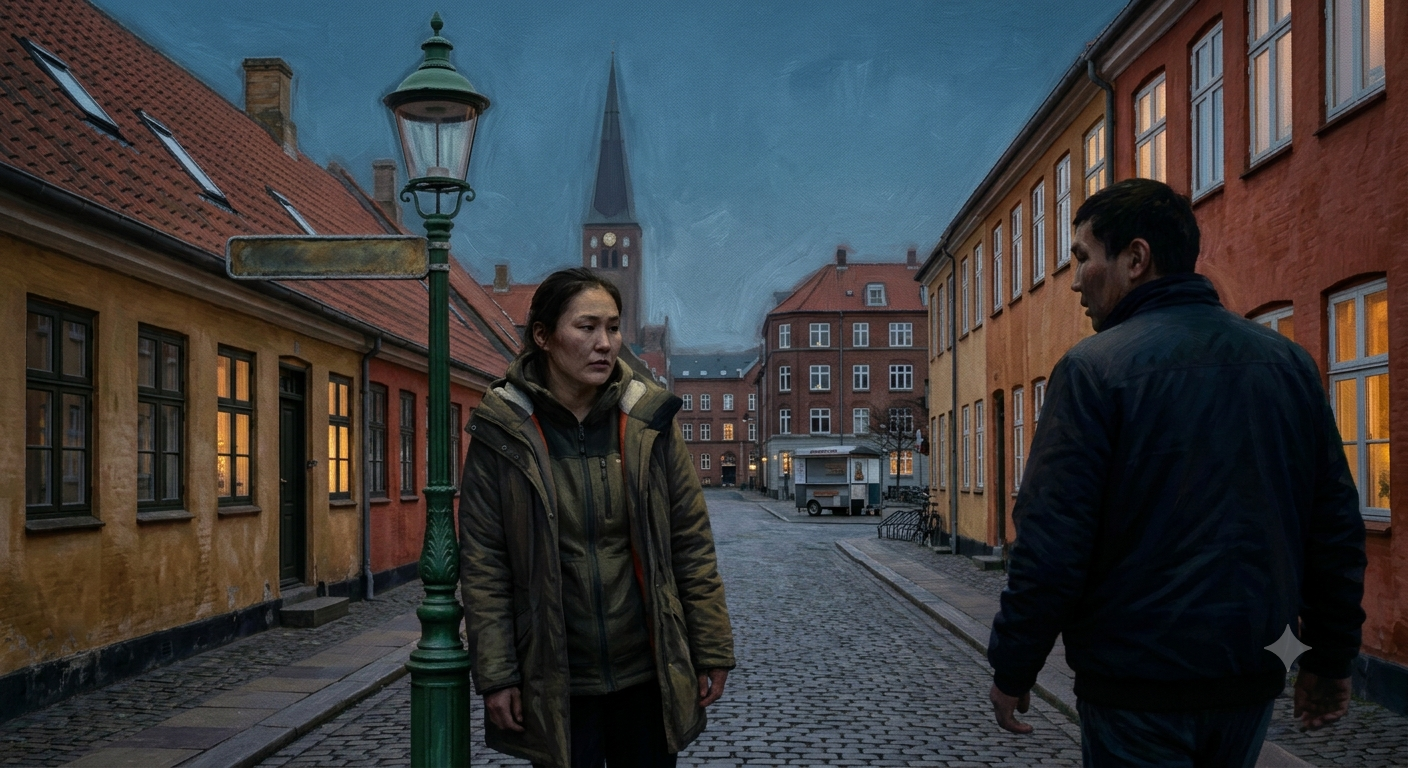
I had never experienced discrimination before, so it hurt the most when a Greenlander, who spoke almost exclusively Danish, said to me, “Man, your Danish is really bad,” and left me alone in the dark.
My first experience with discrimination stemmed from the fact that I explained to that person how difficult it was for me to learn to pronounce words containing the letters æ, ø, y, and å, because I didn’t use them in everyday life. That’s when I realized that other Greenlanders were under so much pressure themselves that they felt justified in belittling even those who were learning Danish.
Or had they themselves experienced so much belittlement from Danes or Greenlanders because of their language that they felt they, too, should bully, belittle, or find fault with those who were struggling to learn Danish or another language?
I myself am incredibly lucky that I haven’t had any Danish classmates, nor have I met anyone who looked down on me because of my language. That’s why I have no right to criticize or belittle other Greenlanders who feel discriminated against.
It’s frustrating to think that we Greenlanders are expected to speak Danish flawlessly by early adulthood, when we’ve never used Danish or been forced to use it throughout our childhood. And I feel that there are a great many Danes who don’t think about this, and that they—“without meaning to” or by accident—end up doing the opposite and creating obstacles to learning Greenlandic.
One example is when I was studying to become an AFIS Operator 1 in Aarhus, and a Danish instructor explained just how different our learning methods could be. During the presentation, the instructor played a YouTube video of a professor explaining how the brain works. The video showed that even at age 70, you can learn a new language if you have the will and motivation to do so.
After the presentation, our teacher said with a smile: “But don’t think I haven’t tried to learn Greenlandic—I HAVE, BELIEVE ME—it’s way too hard.” And I replied, “Maybe you haven’t tried hard enough.”
There was no reply, but someone commented that I talked and criticized too much.
I took the AFIS course in Denmark alongside the Danish students.
If I hadn’t learned Danish and had walked in and said, “I’m sorry, but I can’t speak Danish because it was too hard to learn,” then of course I wouldn’t have started there, and maybe I would have been labeled as someone who didn’t want to learn. It’s really thought-provoking to look back on these absurd incidents as an adult and to be told, “Wow, you’re really good at Danish.” I no longer feel like saying thank you when people tell me, to my surprise, that I’m good at speaking Danish and English; now I reply, “Well, I had to.”
I didn’t learn Danish just for fun; it’s not a hobby. I worked hard to learn it when, as a teenager, I realized it was necessary for my future.
______________________________________________________________________________
1 AFIS = Aerodrome Flight Information Service, a service in which the operator provides aircraft with information on, for example, weather and flight conditions.
In fact, I’ve also had to learn Danish so I could understand those Danes who didn’t think it was important to learn Greenlandic. That way, I could talk to that one Dane who “didn’t want” to learn Greenlandic at a Greenland-owned workplace with Greenlandic employees, and translate for those who couldn’t understand Danish.
Even though I don’t feel discriminated against by Danes, I’m now fighting to speak out loud and clear that there are plenty of opportunities for us to learn anything and any language.
Of course, it’s possible to learn Greenlandic even if you speak Danish. I believe that foreigners should also see this as a duty. If they’re going to live and work in Greenland for a long time, they need to learn Greenlandic. That way, we can interact on a more equal footing when we speak the same language. We’ve invested so much effort and money into learning it, and it shouldn’t just be us who have to make sacrifices for the language. It has to be a two-way street!
Author: Sikkerninngaq O. Gärtner
Publication: The Greenlanders
Writing partner: Ivaana Aagga Geisler