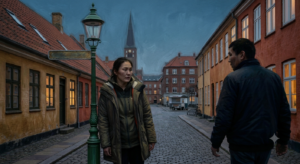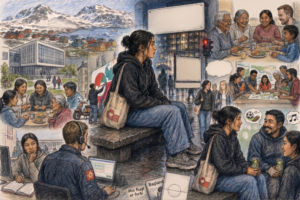
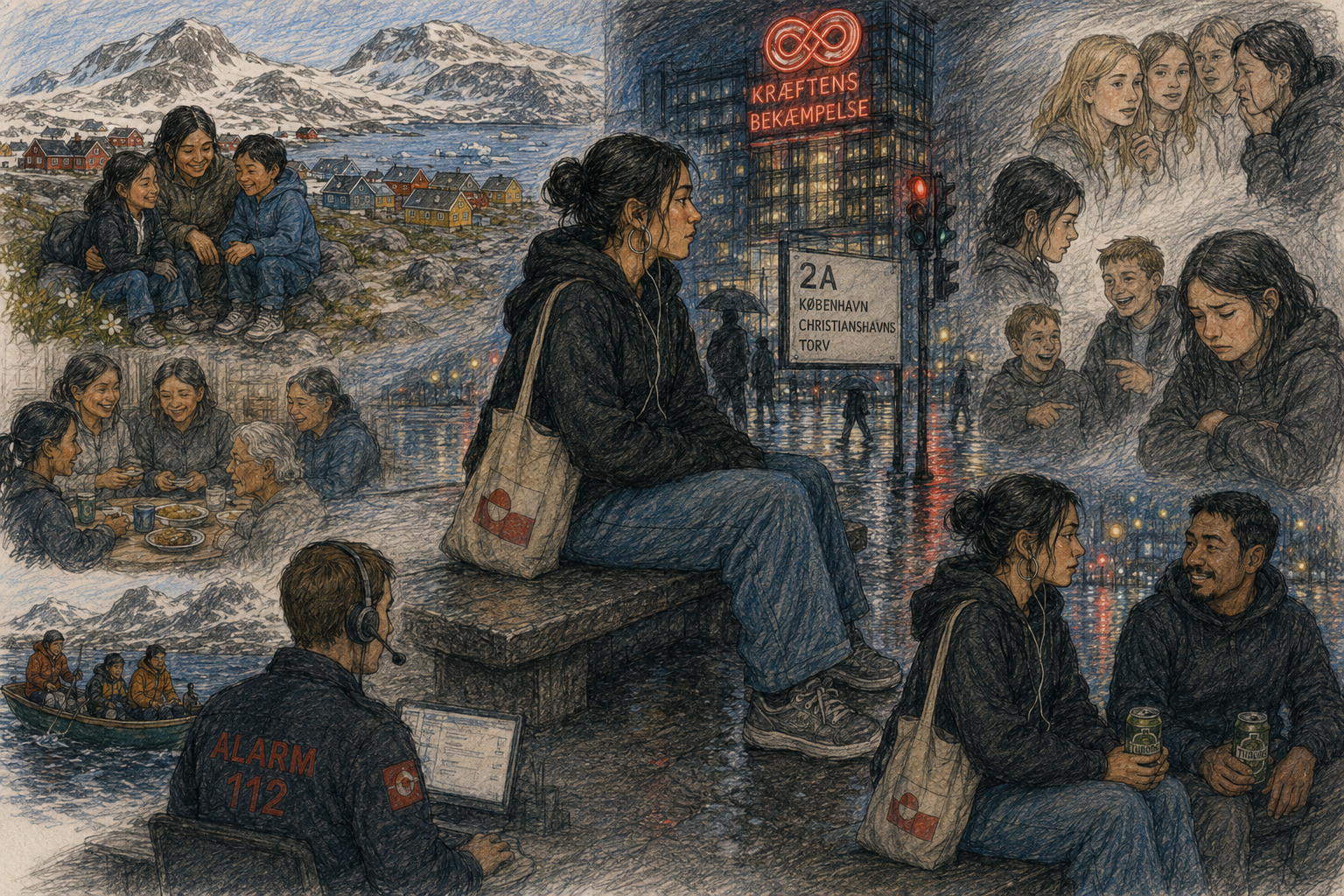
I’m sitting here waiting for the 2A at Christianshavns Torv. I can feel the cold stone bench beneath me. The small awning above me offers a little shelter from the rain, but the drops are still hitting the tips of my shoes, which are now soaked through. The changing lights of the traffic signal reflect off the wet asphalt, and I watch as the colors shift in the raindrops and the shadows of people crossing the intersection. The cord of my headphones is tangled around the strap of my bag, so one earbud falls out of my ear. I hadn’t put any music on anyway. It just helps me pretend I can’t hear them speaking slurred Greenlandic behind me. They’re drunk; they’re almost always drunk. I can’t understand Greenlandic anymore, but hearing them speak the language gives me a secret sense of calm. For a moment, I can pretend it’s snow falling quietly instead of rain, and their voices become my family talking.
However, it is quickly interrupted by a rough voice, and I think to myself that they’re arguing again. I try not to look up, because I know what I’ll see: the stares from those waiting for the bus. The same stares that expect me to do something about the situation—that since I’m one of them, I have a responsibility.
Instead, I look up at one of the roofs by the square. That roof is my first memory, from when I came to Denmark as a three-year-old. I remember the bright red light high up on the building; it spun in circles and shone differently from other lights. My father held me in his arms after the long journey, and it was overwhelming for me to be surrounded by the tall buildings around the square. I couldn’t read what it said back then, but I know now that it was a neon sign advertising the Danish Cancer Society.
Before my father and I moved to Denmark, we lived in Greenland with my mother, brother, and sister. Technically, my siblings are my half-siblings, but I’ve never thought of them that way. After my parents separated, they naturally had to stay with my mother, while my father took me, his only child, to Denmark, where he is from. However, there is nothing natural about being away from one’s family for a little girl.
When I was a child, many adults asked me why my parents weren’t together, or why my mother still lived in Greenland. I still can’t understand why anyone would ask a little girl those questions. It’s always been hard to talk about, because I miss my mom, of course. It also always seemed like I was answering something wrong, because the adults would just look back at me with a pitying gaze that I didn’t quite know what it meant. To this day, there are still many who ask me probing questions. Now, of course, I’m an adult and have a different understanding, but an automatic response that has stayed with me is a sigh followed by: “My mom is Greenlandic, that’s why she’s in Greenland.” I always get a slightly confused look in return, but I let it be what it is. I try not to make it my responsibility to defend my parents’ choices.
I’ve always been asked very intense questions. I don’t know if it’s normal to have to explain your upbringing, or if people just get carried away by their curiosity. After all, it’s not that common for a little girl to grow up with a single father, or for the mother not to be very much in the picture. In movies and the like, the mother is always gone because she’s dead. In that sense, I haven’t had much to look up to. The intense questions don’t stop at my family; they also concern Greenland. For many years, I tried to learn as much as I could about Greenland, our history, and what it’s like now, to compensate for the fact that I have no idea what it’s like to live there. I tried to pretend I knew. I felt I had to when I had to explain that not all of Greenland is plagued by alcoholism and social problems—that there is also a lot of beauty in Greenland, and not just in nature.
However, I always visited Greenland quite often during my childhood—about twice a year, for three weeks at a time, usually during summer vacation or at Christmas. Back then, it was always Nanortalik in South Greenland. I loved it; I felt at home. The boisterous Greenlandic voices from the town square were replaced by my family’s. I could feel how I fit in. How the mountains embraced me instead of five-story buildings packed tightly together. There was fresh air and blackberries to pick out in the mountains, trips to drink spring water, and fishing trips with my cousin’s family. I would suddenly be able to remember more Greenlandic, as my family would use the little everyday words with me, which I could either remember or understand from context. I was thoroughly spoiled, because I’m my mother’s youngest child. She was never supposed to raise me—that was my father’s job—so I got candy and cake almost every single day. I wasn’t allowed to tie my own shoelaces; my mom did that for me. I think it was her way of making up for not usually being there. I loved the care, so I let her do it, even though I was way too old to need that kind of help.
It was hard every time I came back to Denmark, both because I missed my mom, my family, and Greenland itself. Denmark is my home, of course, but there was so much focus on hair color, eye color, and skin color that I felt like an outsider. It wasn’t cool to be Greenlandic. The hair on my arms was dark and not like the other girls’. A boy once pinched my arm and called me a monkey. One of the boys in my class thought the word “Greenlander” was the same as “alcoholic.” At the time, it felt hopeless to say anything about it, since we lived right next to the town square, where you could see drunk Greenlanders every day. So I decided that instead, I had to show that I was the exception. I was afraid of being looked at the same way as the Greenlanders in the square. It quickly turned out, however, that it wasn’t so easy to be the exception in a culture where alcohol is the focal point for most young people.
When I started drinking and going to parties myself, I was often told I was “pretty for a Greenlander.” Back then, I took it as a compliment. I wanted so badly to be blonde and blue-eyed that I had convinced myself that must be the right way to be. I even ended up bleaching my hair platinum blonde. It took about six to ten bleaching sessions to get just the right color. When I was sixteen, I went to visit my mother, who had since moved to Nuuk. It was my first time going there, and I was excited. I was tall and slender and had glowing, blonde locks. I thought I was going to be a superstar. I had packed all the nicest clothes I had, which would be perfect for the summer weather in Nuuk. On the first day, we went downtown to shop; I was all set, fully made up and head held high. As I walked down the street in the blinding sunshine, I saw a woman. Her cheekbones were high and sharply defined, and her eyes were brown and beautiful. Her black hair was pulled up into a bun, which made her look cool without even trying, and that’s when it hit me: I wasn’t special. For the rest of the day, I walked around feeling a little disappointed, but I learned my lesson. There’s no point in calling me “a beautiful Greenlander,” because that’s not true. I’m just beautiful and Greenlandic.
That kind of “compliment,” however, wasn’t the only thing I encountered. I started drinking very early on; the first time I was thirteen. That wasn’t unusual in Christianshavn. I did it with my close group of friends at the homes of those who were home alone, and otherwise on the street. As I got older, I went to more parties and started meeting more people through them. As soon as they heard where I was from, they would ask if I was an alcoholic too. When I got drunk, they called me “Greenlandic drunk.” I was told that I must like beer, since I was Greenlandic.
But I was full of resilience and tried either to point out their problematic comments or simply walk away from those who treated me that way, yet doubt still began to gnaw at me. I had a hard time stopping drinking once I’d started. I had blackouts every weekend. I started to think that maybe they were right—that I was different, that it was a curse I had inherited. I drank so much because I couldn’t handle my emotions, but I began to believe it was because I’m Greenlandic. No one ever said the same thing about my Danish friends. They drank just as often as I did, but they were cool, and they were proud—with drinking games and competitions to see who could drink the most. It just never felt the same when I did it.
My thoughts are interrupted by the piercing sound of sirens and the blue lights flashing against the street’s facades. It’s not an uncommon sight in Christianshavn, but I’m still keeping my fingers crossed that they won’t stop here at the square. They sometimes do that to calm down the people sitting behind me. It’s just excessive when three cars pull up to settle a quarrel. It seems contradictory that such a large emergency response shows up for a fight when it’s been missing in far worse situations—and suddenly I’m sitting there again, fourteen years old, waiting in vain for someone to intervene.
My friend and I are almost at the bridge leading to Kløvermarken when we spot a figure lying in the dark, face pressed flat against the asphalt, completely still and motionless. He is briefly illuminated by the white bike lights of passing cyclists. They must have seen him, yet they ride right past him as if nothing had happened. I try to make eye contact with a group of adults walking past him, but no one catches my gaze. It dawns on me that no one intends to do anything. My friend and I have to step in when none of these adults will. We walk closer, turn him around, and I get a sinking feeling in my stomach when I realize he smells strongly of alcohol and tobacco. I’ve never helped someone who’s collapsed before, and I don’t know what to do.
My friend calls 911. She speaks briefly on the phone before hanging up and saying, “They actually just asked if he was Greenlandic?” It’s as if all the air in my lungs won’t go in or out. My thoughts immediately turn to a story I heard recently. A Greenlandic man in Amager had died because the paramedics hadn’t taken his condition seriously when they heard he was Greenlandic. But I simply hadn’t realized that their asking about it would be more than just an isolated incident.
It feels like an eternity before the ambulance shows up.
I will never forget that night. Ever since that day, I’ve been afraid that if I ever collapse on the street while drunk, the emergency dispatchers will ask if I’m Greenlandic. Would the person calling answer yes? Would the emergency dispatch center decide not to help me? In that situation, perhaps the only things that matter are whether I have dark hair and narrow eyes, and whether I’m worth saving.
I snap out of my thoughts and look up as a man sits down next to me on the stone bench in the square. I notice the green six-pack lying to my left. He smiles kindly, “Kalaallit nunaaninngaaneerpit?” I apologize and say I don’t speak Greenlandic. “Are you from Greenland?” I answer “yes.” I’m a little nervous, but he doesn’t seem to have had anything to drink yet; it’s probably his first beer of the night. He asks if I want one of his beers. I first consider what people might think and look around. I look up, and immediately I’m met by the stares I’m so nervous to see. They look at me as if they need to save me, or as if they despise us. I think, “Fuck it.” I have a beer with him. We talk about where we’re from in Greenland. He’s also from South Greenland and smiles when I mention my mother’s name. I give him a cigarette, and I let the bus drive by. People look away again, or maybe it’s me who isn’t seeking their gaze anymore. I don’t care; I got a free beer and am talking to a friendly man. It’s not so bad.
Author: Nora Naasunnguaq Geraae Holm
Publisher: De Grønlandske
Co-author: Amanda Westphal Johansen
This series is published in collaboration with the Youth Bureau