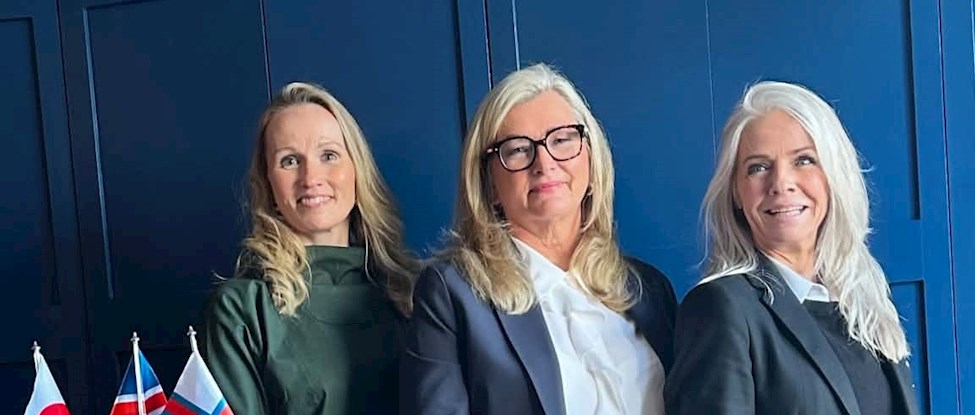
Representatives from Greenland, Iceland, and the Faroe Islands met on August 26–27 for the West Nordic Health Ministers’ Meeting in Reykjavik. The meeting focused on how the three countries can strengthen their cooperation on some of the health challenges that particularly affect small and geographically dispersed communities.
The agenda included topics such as the organization of the healthcare system, digitalization, rehabilitation, psychiatry, the recruitment and training of healthcare personnel, the mental health of children and young people, and prevention.
Naalakkersuisoq for Health and Persons with Disabilities, Anna Wangenheim, sees significant potential in closer and more practically oriented West Nordic cooperation: “We
have different health care systems and different societies, but many of our challenges are similar. That’s why our cooperation must be about more than just exchanging experiences. We need to get better at translating each other’s knowledge into solutions that can actually be applied in our own countries. This applies, among other things, to recruitment, digitization, psychiatry, and prevention.”
A particular focus during the visit was alcohol prevention. Greenland is implementing a multi-year, evidence-based alcohol policy, and Naalakkersuisoq therefore used the visit to Iceland to specifically gather insights into how recommendations and evidence-based knowledge in the field of alcohol are put into practice in other West Nordic societies.
In Iceland, Anna Wangenheim met with, among others, the NGO FRÆ, the National Medical Office, and Iceland’s Minister of Finance. The discussions provided various perspectives on prevention—ranging from public health initiatives and the role of civil society to the economic and structural measures that can support a long-term alcohol policy.
For the Naalakkersuisoq, it is crucial that evidence does not merely result in recommendations on paper, but is translated into initiatives that work in the Greenlandic context. “We
already know a great deal about which measures have a documented effect in the area of alcohol. The next—and more difficult—question is how we translate that knowledge into a coherent policy that works in our society. That’s why I’ve been focused on gathering very specific insights into how Iceland—and also the Faroe Islands—are implementing the same evidence-based recommendations while adapting them to their own circumstances.”
She also emphasizes that a long-term alcohol policy is not solely a matter for the healthcare system: “Alcohol
affects far more than just our disease statistics. It impacts children and families, social conditions, education, the labor market, and our overall public health. That is why prevention also requires us to work across sectors and dare to look at the entire chain—from early prevention and treatment to availability, regulation, and the policy frameworks we create around alcohol.”
The visits to Iceland demonstrated, among other things, how prevention can be embedded across government agencies, civil society, and policy areas. These insights will inform Greenland’s ongoing efforts to translate its multi-year, evidence-based alcohol policy into concrete initiatives.
During the meeting of health ministers, there was also a focus on opportunities to expand West Nordic cooperation in areas where small health care systems face particular shared challenges. These include access to specialized expertise, recruitment and retention, digital health solutions, and psychiatry.
The participants also visited Landspítali, Iceland’s university hospital, where organizational structure, patient care pathways, and retention of healthcare personnel were among the topics discussed.
During the meeting, Iceland’s Minister of Health, Alma Möller, emphasized the importance of investing in public health and prevention as a prerequisite for a sustainable healthcare system, while also highlighting the shared responsibility among authorities, civil society, and citizens.
For Anna Wangenheim, the link between evidence, policy tools, and practical implementation is a key takeaway from the visit: “We
don’t need to copy each other’s models. But we must be curious about what works, why it works, and what can be adapted to our own circumstances. If Greenland, Iceland, and the Faroe Islands systematically share both our positive experiences and what hasn’t worked, we can each make better decisions. That is the kind of West Nordic cooperation I would like to strengthen.”