Are you dreaming, Dad?
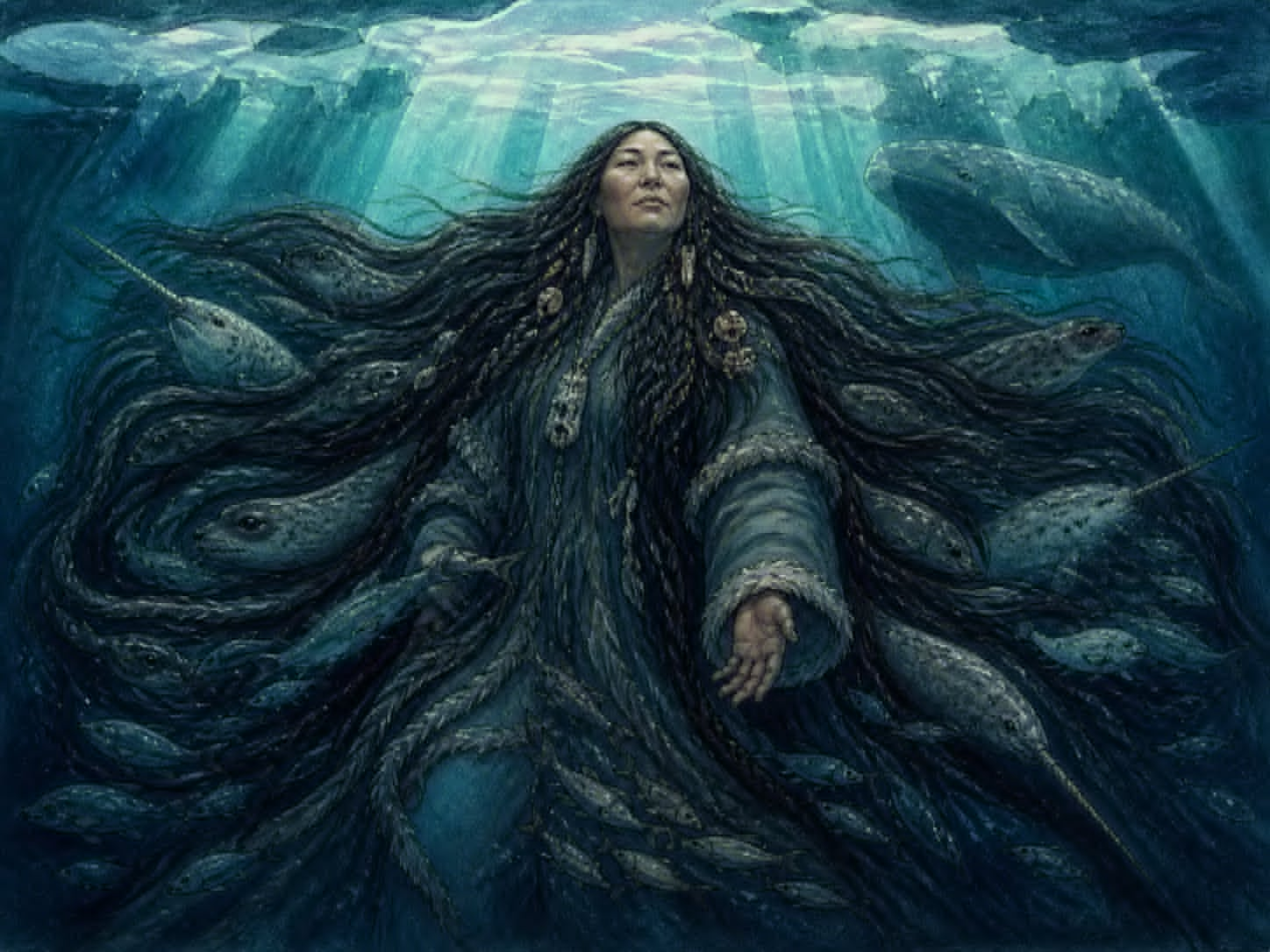
I hope you’re dreaming of vast oceans, beautiful forests, and fields teeming with wildlife. I hope you’re lying there dreaming of delicious fish and a big catch. Or are you swimming around in the ocean with Sassuma Aana, the soul of the sea, who takes care of you and the whales, seals, and fish? Sleep well, Ataata. Goodbye.”
Takuus Ataata – See you later, Dad
My father looks so peaceful in his little urn on the small table; a candle is lit, and a photo of him sits on top of the urn. He’s smiling, and the wrinkles cradle his eyes—my eyes, the wrinkles I’ll have in the future. I’m 28 years old. A month ago, I held his hand while begging him to look at me one last time: “Please, Dad, won’t you open your eyes and look at me?” Only loud beeps and the rustling of the nurses were my only response. “Dad, it’s Freja sitting here—can you hear me?” A squeeze, as hard as his large, outstretched hands could manage. I couldn’t keep sitting there; I couldn’t talk to any more people in white coats with their eyes closed. So I took the train back home from Falster to Copenhagen. The next day, he opened his beautiful eyes, and over the weekend he was moved to a new room. On Monday morning, he died. November 6, 2023. As he lay there, I wished he were with the sea and its mother. I gave myself a dream—a hope for where he would go. Hunter, fisherman, musician, artisan, firefighter, friend, brother, son, and father. The old Greenlander who should have lived to be much older. He gave me my blood, my strength, my survival, my skin, my eyes.”
When his mother died, he said, “So now she’s been taken,” and the next day he found a qajaq right where we’re now going to scatter his ashes—right where he walked his dog every day for 30 years.” I’m in the middle of giving a speech for my father. We’re standing in the beach hunters’ cabin in Stubbekøbing. The room is filled with old friends, family, and a handful of my own friends who wanted to come and support me. I conclude with: “I hope she welcomes you warmly—she, the soul of the sea—now that we’re sailing out to scatter you. Please say hello to them all and raise a toast. Takuss, Ataata!” I can’t believe I did that. Did I just do that? Is this really happening?
But I wanted to—the speech came out as a rapid stream of words; I wrote it in a quarter of an hour. I hug everyone who wants a hug; I thank everyone who thanks me. I float through a stream of mouths and eyes and hands, and I smile and drift along in waves of love. The current sends me off on a new journey. It forms questions I haven’t received answers to; they bubble up beneath my skin. Spirits awaken in my bones and send me on my way. I want to get to know myself better; I want to get to know this ancient sea that has surged up inside me. I just wish it had come a little sooner, while he was still here.
The Girl Who Sought the Mother of the Sea
I’m six years old and sitting on a dog sled wearing an anorak, holding my great-grandmother’s ulu—a Greenlandic women’s knife—which I now have tattooed on my left arm, right next to my heart. We’re going to perform a short play about the little girl who went in search of Sassuma Aana. I’m the only one in my elementary school class in Stubbekøbing with Greenlandic heritage, and I’m so upset that I didn’t get the lead role. I would have loved to be Pani, who saved the catch and the village. Surely it should have been me?
I don’t remember us talking much about my father’s childhood or memories of Greenland. I learned to count to five with a burning desire to learn the language my father could no longer remember. Like something you’d love to own, but that got lost in the chaos of moving from Nanortalik to Qaqortoq to Amager, only to perhaps vanish for good in Nykøbing Falster. Every year we sang a Greenlandic Christmas carol around the tree: “Gavida, gavida, gavinjaput.” We sang loudly, laughed, bowed, and shook our heads, as is customary, while the candlelight shone alongside the Greenlandic beads on the tree.
We never talked about being different—that’s just the way it is. We spent a lot of time out in nature, by the sea, because it was peaceful there, and you could just be yourself. We ate lots of fish, shrimp, and game. Gravy and new Danish potatoes. Several kilos of mushrooms, which we gathered in the wild, and even more kilos of rapeseed, which we harvested from the garden. We rarely spoke of those who were no longer with us, but I learned early on that some people die young, and life can be harsh. All these lives lived—with voices that are no longer here—were there to be found when we packed up my father’s house. Among many things, I found a sealskin, a mask, an embroidered pillow featuring a dog sled and women in traditional dress, eight beaded bells, three photo albums from Nanortalik and Qaqortoq, and Nini Alice’s sewing box. I carefully placed our small inheritance into boxes labeled “GREENLAND.” All these voices that could provide answers to my growing questions. “Who am I? Where am I? Where do I come from? Can you answer that for me?”
A Stranger in My Own Country
I’m 25 years old. We’re sitting in a bodega late at night, with smoke and beer swirling around us. “Well, isn’t Denmark the best country that could have colonized Greenland?” My boyfriend gives me an arrogant look and then continues: “…I mean, if we’re going to imagine an alternate reality, imagine if it had been Russia or the U.S.?” My ancestors rage within my soul; my whole being aches. If we’re going to imagine an alternate reality, can’t it be one where no one colonizes, and everyone gets to keep their own country!?
Next month, we go for a long walk along the fjord in Valbyparken. I feel like screaming and shouting. Deep wounds are being torn open, and I can’t answer anything—I can’t debate, I won’t, and I can’t. “Come on, Freja—you’re not oppressed. Denmark doesn’t even colonize Greenland anymore. You’re not really Greenlandic either—you don’t even speak the language? You don’t even look like one. So how could you possibly know anything?” He’s holding my hand in a firm grip; I can’t break free, can’t shake the feeling of failure—failure on his part, the man I love, and failure on my own part, because I can’t stand up to him. I can’t tear myself away from him and save myself. “Just remember that I wrote my bachelor’s thesis on Greenland, so I know what I’m talking about.” My cheek is wet with anger and icy tears, and I shake my head. I just shut down, shut down, and disappear. I shut down my voice and my ancestors. When news about Greenland comes up, I’m afraid of what he’ll say. When others talk about Greenland, I’m afraid of what he’ll say. It spreads like poison through my body; I stop using my voice. I become afraid of what others might say, and of what I can’t say in response.
But I also see faces on the street, see faces in the voices that can’t place me. After all, I don’t exactly look like a Dane, do I? Spit, nicknames, and scrutinizing eyes wander over my hair, my skin, my story. That sense of being an outsider settles over me like a piece of fabric fluttering across my skin. It wraps itself tightly around me and clings to me every time I’m asked those alienating questions.
Because I don’t know anything at all.
“You’re not entirely Danish, are you?” “Aren’t you from Africa?” “Excuse me, but are you from Brazil?” “You’re not from Greenland, are you?” “That can’t be right! With that hair?” “But what percentage?” “WHERE ARE YOU FROM???” “You can’t tell just by looking at you??” “You can’t possibly be just Danish and Greenlandic, can you?” “You must be descended from some of those people.” “You must have some of that in your blood.” “Have you taken a genetic test?” “You’re lying—you’re from Brazil!?” “With that hair? That’s not very Greenlandic, is it?” “Well, you’re the exotic Greenlander, after all” “Can I touch your hair?”
I, who recognize myself
We’re not together anymore—the guy who made me feel so insecure and speechless. I’m 29 years old, standing on Saxogade, and I’m in the process of closing up the café. An Inuit woman walks past me; I smile at her and raise my eyebrows. She raises her eyebrows back at me and SEES ME. “Have a really nice evening,” she says as she passes me. We’ve recognized each other’s spirit; we’ve seen each other. Moved, I lift one of the benches and set it on the café table; a small tear kisses my cheek. I smile, taking a deep breath, and think: Oh, it’s just the best when that happens. When I feel recognized. If I know I’m going to be somewhere with other Inuit, I catch myself pulling my hair back tightly, putting on beads, remembering to furrow my brow and scrunch up my face, and smiling warmly. I tuck my big hair away and show off my tattoo. I’m afraid they won’t be able to see that I’m one of them, too.
The first time I visit Nunarput Kalaallit Nunaat, I’m 15 years old. “Immuksukkullu?” The old man looks at me. We’re on a sled ride—my grandmother, my mom, and I. The mountains are covered in snow, and we have a view of the ice sheet melting into the sea. The sun is shining, and it’s the most beautiful day in a hundred years. I look back at him, puzzled, and stammer, “Excuse me?” He smiles back and raises his eyebrows: “Milk and sugar?” A warm wave of joy spreads through my chest. Did he really think I spoke the language? Did he just ask me that? A feeling of coming home has been here since the very first day. A longing that has been swimming around in my chest eases a little as we land in Kangerlussuaq. My longing lessens even more as we sail among the icebergs, and the sun kisses every breath I take. It disappears as we drive to the ice sheet and step onto the clear ice. My longing thanks him for his question about “immuk sukkullu.” It so badly wants to answer and say: “Aap, qujanarujussuaq.” It so badly wants to stay in this magical land with these magical people, who awaken the magic within me. My father never came home again; he kept putting off the journey. He should have been here; he should have stood on the mountain again in his physical form.
Perhaps he was afraid of no longer being able to speak the language? Of never being seen again? Perhaps his longing cried out and screamed until it was nothing but an inner storm without words. I know this was the first place he swam to after we scattered his ashes in the water off the northeast coast of Falster. Swimming in the company of his brothers, who are no longer here, into the open embrace of Sassuma Anaana. Onward to the realm of the spirits.
When am I Greenlandic-Danish enough?
But I just have to be myself, because I’m just me.
I’m not half or a quarter or one and a half—I’m a whole person. I’m
Inuk. I’m a mermaid; I’m salt and sugar and gravy with red currant jelly. I’m Danish.
I’m beautiful and good and real, just the way I am.
And no, you’re not allowed to touch my hair.
Asavakkit Ataata – I love you, Dad
My voice has returned. The ice has melted; my spirit has awakened.
My father lies in a hospital bed with his hands folded.
He’s holding a small bouquet of flowers, and a feather is tucked into his hair.
Grief settles like a long breath, spreading throughout my body and hanging over me. A sense of relief lingers beneath it—he is no longer in pain. One by one, we hug each other and look at him, talking about his final days. It’s the first dead body I’ve ever seen. His spirit has flowed out of his body and taken on a new form. He’s probably standing in there with us, in a sterile room filled with warm-hearted people who are crying. We’re about to say our final goodbyes. My new boyfriend walks over and takes his hand: “Goodbye, Erling, take care.” I slowly follow him and sit down, placing a hand on the cold body. My voice trembles, and I can barely speak. Very softly, almost silently, I manage to whisper: “Hi, Ataata, so it happened, huh? Asavakkit.” I swallow and look at his closed eyes, the freckles on his old face; I etch the image into my mind. “Have a safe journey, Papa. Goodbye, takuss.” My throat is like a river. A large rock sits there, blocking the flow, and outside my throat, tears stream down from my eyes. His eyes. I kiss him on the forehead and step away from the bed. It’s too late to dwell on all the things I never got answers to. I’ll have to look for them somewhere else. In the ocean, in the part of him that’s a part of me, in those of us who are left behind, those of us who are different, those of us without a father.
I need to talk to people who feel the same way—or to those who don’t. One day I’ll be able to swim away on my own, and by then it won’t matter anymore, because I’ll have found peace.
Author: Anonymous
Publisher: De Grønlandske
Co-author: Rikke Laursen Bjerg