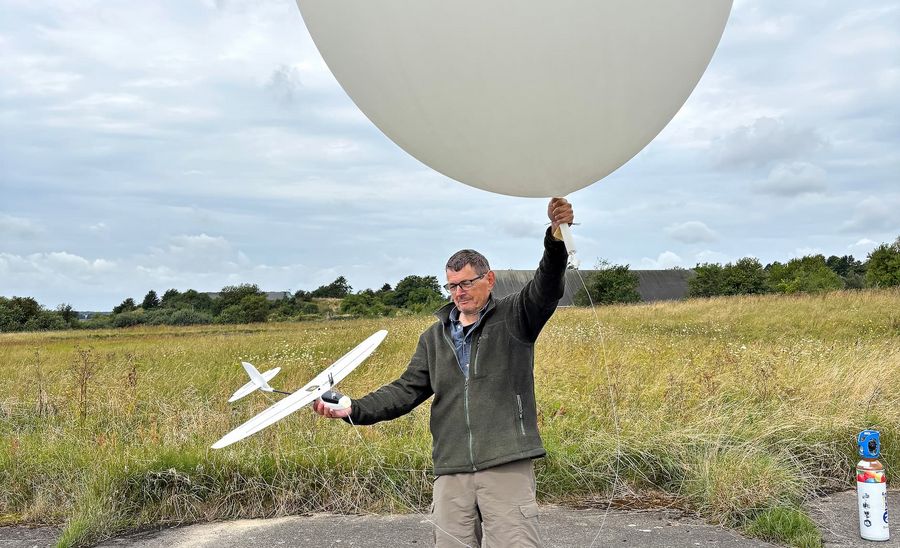
The Danish Meteorological Institute (DMI) is currently testing a new method that could reduce litter in the Arctic environment. At the Danmarkshavn weather station in Northeast Greenland, small gliders will attempt to safely retrieve radiosondes after they have taken measurements high up in the atmosphere.
Radiosondes are typically launched using weather balloons to measure factors such as temperature, humidity, air pressure, and wind. The data is used in weather models around the world and is essential for more accurate weather forecasts.
But when the balloon bursts at high altitude, the equipment typically falls to the ground in a random location. This means that plastic, electronics, and batteries can end up in the natural environment.
Must land near the launch site
The new experiment involves attaching the radiosonde to a small glider. The glider weighs about 250 grams, is made of lightweight foam, and has neither an engine nor a pilot.
When the balloon is released at an altitude of about 30 kilometers, the glider will glide back in a controlled manner and land near the weather station. This allows both the glider and the radiosonde to be recovered and reused.
“Our initial goal is to minimize the environmental impact of our equipment. We’ll only achieve a small financial saving if the experiment is successful. If it works, we’ll repeat the process with the probes that measure ozone in the atmosphere—they’re in a different price range,” says Jacob L. Høyer, who heads the DMI’s Satellites and Arctic research unit at the National Center for Climate Research.
The experiment is being conducted in Danmarkshavn, located in the North and East Greenland National Park. There, staff launch radiosondes twice a day, year-round. This amounts to approximately 730 balloons carrying equipment per year.